What’s Wrong With October?

The CMA opened its Phase 1 investigation into the Vodaphone/Hutchinson merger today.

The parties will be hoping to defy the track record of CMA merger cases opened in October:

  • Phase 1 clearance rate only just above 50%
  • Phase 1 remedy rate = 50% above average
  • Phase 1 reference rate = 50% above average
  • Phase 2 clearance rate = 50% of average.

Ranking within months of the year – respectively:

  • 2nd worst
  • Worst (unless one sees remedy as the best possible outcome!)
  • 2nd worst
  • 3rd worst

What’s wrong with October?

I have my theory. What’s yours?

The CMA Will Definitely Clear This Merger

An investor tells me with certainty that, if the high profile deal in which he is interested happens, the CMA will definitely clear it.

“They (the acquirer) wouldn’t go ahead if they weren’t absolutely sure they could get it through”, he insists.

It’s a view that I’ve heard many times during my investor briefings on mergers from supermarkets to video games.

It’s a bold claim.

Which is why – when it crops up – I usually find myself asking briefing participants the following:

What would have to be the case for it to be true?

What would have to be true for this to be the case?

At which point participants to the discussion tend quickly to alight on three big assumptions:

1. That the acquirer has prepared perfectly for all eventualities

2. That none of the eventualities results in any risk whatsoever that the CMA will find competition problems.

3. That this acquirer would only proceed with absolute certainty of outcome.

When that happens discussion often then turns to how frequently these assumptions have held in similar past cases.

Quite a lot is known about that, under all three headings.

And when that is discussed, guess what tends to happen next.

Twenty Two Too

Fully understanding the prospects for a UK merger control investigation – whether as an investor, a merging firm, or a merging firm’s rival – depends on how well you interpret the CMA’s stance towards mergers and over what period.

I find that the best-prepared look at the CMA’s track record in merger assessments over both the short- and the longer-term, in order to help evaluate what has changed and what is changing.

And they also recognise that developments in the UK can differ from the more global narratives that tend to dominate a lot of merger control commentary.

This is especially important for investors and companies from outside the UK.

With all that in mind, here’s a quick synopsis of key UK themes from my series of posts looking back at 2022 and putting it in the context of what came before:

Which of these themes is most relevant to your merger in 2023?

Phase 2 In 2022

In my previous posts reviewing 2022 I have focused on Phase 1 outcomes.

To complete the picture here are the key figures regarding the CMA’s completed Phase 2 merger investigations in 2022…………………..

The Most To Date…

In 2022 there were 14 final decisions, the highest under the CMA and well above the previous years’ average of 10.

But for some of the merging companies involved there was good news……

Good News?…

First, the deal survival rate (8 out of 14) was the highest since 2017, the last time that survivors outnumbered terminated deals.

Second, the number of Phase 2 remedies accepted (5) was the highest number since 2016.

As I noted in my review of Phase 1 outcomes, remedies at that phase were also at their highest since 2017, a theme I’ll return to in a forthcoming post.

And third, the five Phase 2 remedies included two of the new ‘fast-track’ Phase 2 remedies that are now potentially available to merging parties – Sika/MBCC and Carpenter/Recticel.

Quick Fix Questions…

It will be interesting to see how this new policy works in practice.

Here are two questions about it worth keeping in mind….

1.How will this new fast-track process affect the incentives of the parties to offer undertakings at Phase 1 and overall case strategy at Phase 2?

2. And how might it affect the substantive competition assessment at Phase 2 and thereby change the overall enforcement pattern at Phase 2?

If you have thoughts on this, do feel free to comment.


Click here for an interesting piece on Phase 2 fast-track cases by Sofia Platzer and colleagues

More Problematic Than Not

Number Four in my look back at 2022…..

This was the year in which there were more Phase 1 merger interventions than unconditional clearances (among Phase1 decisions published during the year) – for the first time.

Despite the very low number of published Phase 1 decisions, the number of remedy decisions was well above the CMA average (10 versus 6) and the highest since 2017.

The number of reference-to-Phase-2 decisions was just above the average for previous years (11 versus 10).

Also:

Between 2017 and 2021 the number of references had been more than twice the number of remedies.

In 2022 they were roughly even.

2022 is also, therefore, the year in which Phase 1 remedies came into their own again.

Basement Clearances

This is the third of my posts looking back at UK merger control in 2022……….

The first looked at the low overall number of cases and the second at the near disappearance of so-called ‘de minimis’ cases.

In this post I look at Phase 1 clearance cases.

Here are the figures for Phase 1 clearance cases (in which I include ‘de minimis’ decisions)…

Four points stand out –

1.In 2022 there were just 20 Phase 1 published decisions that reported unconditional clearance, by far the lowest under the CMA.

2. And most of these were in the first half of 2022. The second half saw only 7.

3. It is the fourth successive annual fall and a sharp drop from 2021.

4. And the first year that fewer CMA Phase 1 published decisions reported clearance than did not.

Which all begs the question – Where have the clearance cases gone?

More on this in future posts………..

How The CMA Merger Numbers Are Made Up

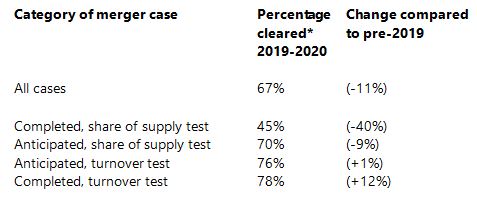
There’s been a big overall decline in the percentage of CMA cases cleared unconditionally (at Phase 1 or Phase 2)* in recent years.

It’s been much commented on and interpreted.

But it’s not quite what it seems when you look behind the headline numbers.There are very different patterns when looked at by case type.

In fact, arithmetically at least, the aggregate change is accounted for by just one type of case.

Here’s the overall pattern for 2019 and 2020 cases, with the size of the different elements proportional to the number of outcomes in each category – where

  • green = unconditional clearance at Phase 1 or 2
  • yellow = remedies at Phase 1 or 2
  • red = prohibited or abandoned …….

Source: Adrian Payne analysis of published CMA decisions

It illustrates how important it can be to look behind the aggregate numbers when considering past or potential case outcomes and when interpreting ‘trends’ in the aggregrate numbers.

In one of my next Merger Insight briefings I’m going to be discussing the reasons behind these patterns and what they mean for companies planning mergers.

—————————————————————————————

(* Percentage of publically-investigated cases. Takes no account of cases the CMA chooses not to investigate publically, on which no meaningful data are published.)

———————————————————————————————

Thank you for reading. If you found the article informative please feel free to share it using the sharing buttons nearby.

CMA Phase 2 Decisions: The Long And Short Of It

There is a lot of interest at the moment as to what governs extension of the CMA Phase 2 timetable and whether extension has been a ‘good or bad sign’ for merging parties.

In my latest Merger Insight briefing yesterday I therefore looked at the Phase 2 cases to date for which the CMA extended the timetable for review – usually by up to eight weeks.

Below is a key chart that informed the discussion.

From left to right it ranks the Phase 2 final outcomes in ascending order of the duration of the Phase 2 process.

Each case is coloured as follows:

  • Black – merger abandoned
  • Green – unconditional clearance
  • Orange – clearance with remedies
  • Red – prohibition

The chart rather explains itself….


About a third of Phase 2 investigations to date have been extended. With one or two exceptions these are concentrated in the right-hand third of the chart.

It’s immediately apparent therefore that the proportion of cases unconditionally cleared has been very low for extended cases – less than half that for cases that ran to the usual timetable.

However it’s not all bad news for parties involved in extended cases. Extension can lead the CMA to become comfortable with a relaxation of remedies proposed at the provisional findings stage and enable late-emerging evidence to be explored in full.

Even so – the fact remains that only just over one in five extended cases have ended up being cleared.

Or – to put it another way – over two-thirds of mergers that have been prohibited or remedied at Phase 2 have involved extended investigations.

The other talking point yesterday was the proportion mergers that parties have decided to abandon. But that’s a story for another day….


For details of my free Merger Insight briefings please click here.


Better Assessment of UK Merger Control Risk

Mergers and acquisitions involve the potential for the relevant competition authorities to scrutinise a deal and, if they think it may harm competition, impose remedies or prohibit it altogether.

This article focuses on merger control in the UK, by the Competition and Markets Authority (CMA).

The better the assessment of these intervention risks (sometimes known as ‘merger control risks’) the better the judgments companies are able to make on matters such as:

  • whether to go ahead with a putative transaction or to re-shape it to mitigate the potential competition risks
  • whether or not to notify deals to the CMA
    • (it’s worth noting here that non-notified deals called in for examination by the CMA were at record numbers in 2018)
  • what they need to do to manage and mitigate risks, both before and during an investigation – recognising the potential for unwelcome surprises, including:
    • unexpected merger remedies or
    • costly Phase 2 investigations that the company hadn’t anticipated
  • whether or not to offer remedies to head off problems at Phase 1 or risk reference to a full Phase 2 investigation.

In practice companies adopt a wide spectrum of approaches, ranging from no risk analysis at all right up to a full replication of the assessment that the CMA might take.

Most lie somewhere in between but many make limited use of lessons from past cases.

As a result companies are regularly surprised by Phase 1 outcomes.

With just over 300 Phase 1 merger decisions now published there are many insights available that companies can use, and in some cases are using, better to assess and manage their  prospects.

Here are four initial steps companies can take to help utilise learning from those decisions much more effectively:

1.Take into account the full range of risk factors identified in past cases, not just some of them.

Ignoring even one of the main risk factors gives an unrealistic outlook which detracts from effective planning.

Risks unrecognised cannot be mitigated or managed.

Looking across past cases, where three of the top risk factors are present the Phase 1 clearance rate has been less than 20%. (And in 2018 it was 0%).

This is orders of magnitude lower than the average clearance rate (of 67%).

What’s more, the problematic deals in this ‘higher risk’ category have been disproportionately more likely to be referred to Phase 2 investigation, rather than being remedied at Phase 1.

2. Recognise the risk in ‘low risk’ mergers

The key here is that:

Low risk is seldom no risk.

This is where CEOs have most often been taken by surprise because

  1. There is a tendency to underestimate risks in ‘lower risk’ cases (especially from factors that are largely or wholly outside the merging parties’ control) and
  2. Mergers in the ‘lower risk’ category account for a large number of cases.

Even in the 73 cases to date where none of the top competition risk factors materialised the CMA found problems in 15 of these ‘lower risk’ cases, of which 6 went on to a full Phase 2 investigation.

15 cases since the CMA began equates to 2 or 3 cases each year. That’s a lot of scope for surprise.

3. Understand the impact of different types of risk .

There are now enough previous CMA decisions to be able to gauge the influence of different factors on case outcomes and to take this into account in focusing effort on the aspects that really matter to building a stronger case.

For instance:

  • What if a transaction involves more than one type of competition issue?
  • What if customers and/or competitors complain?
  • What if a case involves many local markets?
  • What if there are unhelpful internal business documents?
  • What if these factors combine?

In an earlier blog, I looked specifically at the role that so-called ‘market shares’ have played in merger decisions.

And in this one, I showed how merging companies paid too little attention to how closely they compete with one another.

4. Learn from cases that have a similar risk profile

In preparing for a CMA merger investigation most companies take a look at what happened in previous cases in their own sector.

There’s nothing wrong with that but it does mean that a lot of relevant case-learning often goes untapped.

It can be especially insightful to look at what made the difference between clearance and non-clearance in cases with a similar risk profile to your own, including those outside one’s own sector.

In conclusion…

Understanding and managing merger control risks can help avoid costly mistakes and focus case-making effort.

The CMA’s 300 merger decisions to date provide plenty of insights that can be deployed in a very practical way in order better to manage risk and build a stronger competition case.

——————————————————————————————————————-

This article has focused on risk management and is based on analysis from my comprehensive database of CMA merger decisions.

In addition the 300 cases to date offer many other lessons as to how best to make a merger case. These feature prominently in my merger briefings.


More Merger Remedies Than Ever

The Competition and Markets Authority has just completed its fourth year.

One particular development stands out, looking at the pattern of outcomes among the 250+ CMA merger decisions since 2014….

More Phase 1 remedies: Fewer Phase 2 investigations

On average, the Competition and Markets Authority (CMA) has accepted between 3 and 4 more remedy outcomes each year at Phase 1 than the Office of Fair Trading (OFT) which had responsibility for Phase 1 mergers until 2014.

At first glance that increase doesn’t look significant…. until one considers that:

  • the average number of Phase 1 remedies under the OFT was only 5 in the first place and that
  • the CMA has been formally considering 30% fewer cases than did the OFT.

The number of references to Phase 2 is on average just over 3 lower each year than it was before the CMA took over responsibility for Phase 2 mergers from the Competition Commission.

Pre-CMA the average annual number of references was 11.

While there is not be a direct one-for-one relationship between the increased average number of remedies and the lower average number of references, a  link would not be too surprising given the CMA’s stated policy of resolving more cases at Phase 1.

Overall, the percentage of problematic Phase 1 cases resolved through Phase 1 remedies, rather than reference to Phase 2, has been more that a third higher in the CMA’s first four years than for any four-year period under the OFT.

What has been the change in the pattern of outcomes at Phase 2?

The reduction in the average number of Phase 2 cases under the CMA reflects, in order of scale of change:

  • fewer mergers being abandoned on reference to Phase 2
  • fewer Phase 2 clearances
  • the near elimination of Phase 2 prohibitions and
  • a lower number of Phase 2 remedy outcomes.

This is consistent with the notion that, if there is some link between more Phase 1 remedies and fewer references to Phase 2, it is the more ‘marginal’ and more ‘fragile’ that may have been most affected.

If so it means that some cases that might have been cleared at Phase 2 are undergoing merger remedies at Phase 1.

This may be one reason why the proportion of cases being unconditionally cleared at Phase 1 or at Phase 2 is sharply lower under the CMA than it was under the OFT. (Another is the CMA’s greater selectivity in which cases formally to investigate.)

How Are Companies Responding?

Judging from conversations during some of my recent merger briefing sessions ,some companies considering or implementing mergers are already paying much closer attention to the potential for a Phase 1 remedy outcome than used to be the case.

This includes thinking harder about the more expansive types of Phase 1 remedy that the CMA has shown itself prepared to consider and accept.

For some it also means attending more to how they shape and scope their transactions and how they measure the degree of merger control risk they are taking on.

There are plenty of lessons merging companies can learn from the CMA’s 34 Phase 1 remedy cases so far – the subject of one of my recent briefings.

In recent months the rate of remedied cases has come back somewhat from its peak. Looking ahead, it will be interesting to see, therefore, whether we have already reached ‘peak Phase 1 remedy’.