
Subscribe to continue reading
Subscribe to get access to the rest of this post and other subscriber-only content.

Subscribe to get access to the rest of this post and other subscriber-only content.
Subscribe to get access to the rest of this post and other subscriber-only content.
As discussed in an earlier post, there is a widespread view that the CMA has taken a much harsher view of mergers over the past few years.
There are many different ways of trying to measure this.
Here’s one based on my ‘CMA At 500’ analysis……
The CMA has just published it 500th merger decision. What is the picture if one compares the first 250 with the second 250?
Three striking aspects to consider
1. Number of mergers not cleared unconditionally at Phase 1 –
2. Number of mergers referred for an in-depth (Phase 2) investigation –
3. Number of these Phase 2 mergers not surviving Phase 2 –
These rises look dramatic in the context of 250 cases.
On further examination they show:
But what do these movements actually mean?
To assume that changes such as these are wholly down to a tougher CMA stance would be a very big assumption – and one with the potential to deter more deals than it should or encourage firms to misdirect efforts in making their case.
How much, for example, might instead reflect change in
And to what extent are the changes evenly spread, rather than concentrated in particular parts of the case portfolio or particular periods of time (e.g. the Covid years)?
And maybe the answers vary for each of the three ‘swing’ movements listed above.
Searching For Answers
The only way to approach these questions is to delve below the headline statistics published by the CMA and look at the features of the cases themselves.
In my ‘CMA At 500’ research I have used my assessment of the features of all 500 cases to examine these questions, including through the type of analysis discussed in this blog from 2019.
Click here if you’d like me to say more about this topic in future posts.
Do get in touch if you’d like to know more about my ‘CMA At 500’ project
The CMA opened its Phase 1 investigation into the Vodaphone/Hutchinson merger today.
The parties will be hoping to defy the track record of CMA merger cases opened in October:
Ranking within months of the year – respectively:
What’s wrong with October?
I have my theory. What’s yours?
In June the CMA published its 500th merger decision.
There’s little doubt that the profile of UK merger decisions has developed a lot since the CMA began. No surprise there, as a great deal can happen over 9 years.
It seems that many readers (especially advisers) are sympathetic to the first of the somewhat tongue-in-cheek narratives I set out in my previous blog, although with a more measured overarching headline, along the lines that the CMA has become much stricter on mergers.
But what lies below that sort of headline?
What exactly does it mean? And for whom?
And what call to action should it have for merging parties, investors and others?
The reason these questions are important is revealed when one looks below the aggregated statistics that the CMA publishes by using data published in case decisions.
In future blogs I plan to say more on all of this, based on recent research I have been doing looking at the CMA’s first 500 merger cases – ‘The CMA At 500’.
Comparing the first 250 and the second 250 brings out many unexpected similarities and differences.
The ‘stricter enforcement’ narrative, it turns out, is much more nuanced that it might first appear from the headline numbers and applies unevenly across different types of case.
Many companies relying on the simple headline ‘stricter trend’ in thinking about merger control risk will be well wide of the mark. The average is different from the typical.
If interested, do watch out for my blogs on ‘The CMA At 500’ or contact me to find out more about my presentation on the research.
Fully understanding the prospects for a UK merger control investigation – whether as an investor, a merging firm, or a merging firm’s rival – depends on how well you interpret the CMA’s stance towards mergers and over what period.
I find that the best-prepared look at the CMA’s track record in merger assessments over both the short- and the longer-term, in order to help evaluate what has changed and what is changing.
And they also recognise that developments in the UK can differ from the more global narratives that tend to dominate a lot of merger control commentary.
This is especially important for investors and companies from outside the UK.
With all that in mind, here’s a quick synopsis of key UK themes from my series of posts looking back at 2022 and putting it in the context of what came before:
Which of these themes is most relevant to your merger in 2023?
Last week the CMA announced that it has provisionally found so-called ‘vertical’ competition problems with the Microsoft/Activision deal, centring on the popular game ‘Call of Duty’.
A vertical problem is one that results from of the coming together – or greater coming together – of different levels in a supply chain, rather than a combination at the same level.
In the past few days there has been a lot of commentary on last week’s announcement, some of it suggesting that this case is somehow unique or unusual.
So – How unusual is this outcome?
As always, it depends how you measure it. But here are a couple of thoughts………
1……………..
This case is one of 14 where the Phase 1 investigation identified vertical competition problems sufficient to justify reference to an in-depth Phase 2 investigation.
To put this is context, there have been around 90 completed CMA Phase 2 investigations to date.
Five of the previous thirteen survived the CMA process.
This is a very similar survival rate to other Phase 2 cases
2………….
In my assessment, the Microsoft/Activision CMA Phase 2 investigation is one of eight to focus primarily or exclusively on vertical matters.
If the CMA decided to prohibit the current transaction it would mean that three of the eight did not survive the CMA process.
If, instead, the CMA accepted a remedy to the competition problems identified, this would the first among these eight cases.
————————–
There may well be other ways of looking at the question of how distinctive this case is.
Do comment below or drop me a line if you have other perspectives.
This post builds on data from a briefing on this case held in the first week of the year which also looked at the detail of the Phase 2 process and the significance of the extension to the Phase 2 timetable.
Cérélia/Jus-Rol
On January 20th the CMA announced its first merger prohibition of the new year by concluding that merger between Cérélia andJus-Rol is likely to reduce competition substantially and that Jus-Rol needs to be sold to an independent buyer.
It is unusual to see a case in the food manufacturing sector referred to a Phase 2 inquiry. In fact it’s only the second time for the CMA, out of 29 cases to date.
And this is the first to be prohibited.
According to the CMA, Jus-Rol is by far the largest supplier of branded ready-to-bake products in the UK, while Cérélia is the largest supplier of own-label ready-to-bake products, making these items on behalf of some of the nation’s largest grocery retailers.
Key to the CMA’s Phase 2 conclusion were the following findings:
So is this food sector prohibition as unusual as it might seem?
Not if you look more widely than this particular sector.
According to my analysis there have been 10 previous deals with the same pattern of key evidence, across all sectors. Only two have raised no significant competition problems and none have so far survived the Phase 2 process.
The link to the CMA’s Phase 2 report is here.
Number Four in my look back at 2022…..
This was the year in which there were more Phase 1 merger interventions than unconditional clearances (among Phase1 decisions published during the year) – for the first time.
Despite the very low number of published Phase 1 decisions, the number of remedy decisions was well above the CMA average (10 versus 6) and the highest since 2017.
The number of reference-to-Phase-2 decisions was just above the average for previous years (11 versus 10).
Also:
Between 2017 and 2021 the number of references had been more than twice the number of remedies.
In 2022 they were roughly even.
2022 is also, therefore, the year in which Phase 1 remedies came into their own again.
There’s been a big overall decline in the percentage of CMA cases cleared unconditionally (at Phase 1 or Phase 2)* in recent years.
It’s been much commented on and interpreted.
But it’s not quite what it seems when you look behind the headline numbers.There are very different patterns when looked at by case type.
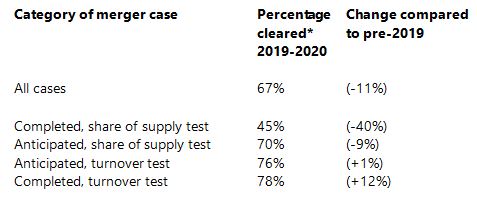
In fact, arithmetically at least, the aggregate change is accounted for by just one type of case.
Here’s the overall pattern for 2019 and 2020 cases, with the size of the different elements proportional to the number of outcomes in each category – where

Source: Adrian Payne analysis of published CMA decisions
It illustrates how important it can be to look behind the aggregate numbers when considering past or potential case outcomes and when interpreting ‘trends’ in the aggregrate numbers.
In one of my next Merger Insight briefings I’m going to be discussing the reasons behind these patterns and what they mean for companies planning mergers.
—————————————————————————————
(* Percentage of publically-investigated cases. Takes no account of cases the CMA chooses not to investigate publically, on which no meaningful data are published.)
———————————————————————————————
Thank you for reading. If you found the article informative please feel free to share it using the sharing buttons nearby.
 Adrian Payne