Looking Into Carving Out

It’s been a great pleasure working with my friends at Aldwych Partners and NOCON on a study of merger remedies that the CMA has published today, alongside its own report.

The focus has been on so-called ‘carve out’ merger remedies.

These remedies involve the divestment of a combination of assets, contracts and staff, which were not previously a self-standing business or business unit.

Overall, our case studies show that carve-out remedies carry significant risks to their
effectiveness and that risk mitigations, such as fallback remedies, may only be of limited use.

Where the CMA concludes that a carve-out remedy is likely to be effective in addressing
competition concerns, the case studies indicate that additional safeguards may be warranted to address their risks.

——-

Key learning points from our five case studies, include the following:

  • Carve-out remedies that unwind or undermine economies of scale, density or scope can be expected to significantly increase the risk to the remedy’s effectiveness.
  • Carve-out remedies can provide merger parties with greater opportunities to influence the content of a divestment package and, through this, limit future competition.
  • Carve-out remedies that transfer customers to a new supplier will depend on
    customer consent and this can pose a substantial risk to these remedies’
    effectiveness.
  • Carve-out remedies pose additional challenges for purchasers’ ability to carry out
    effective due diligence as the divestment package is not based on a pre-existing
    business unit.
  • Merger parties may be able to weaken future competition through their influence over the choice of purchaser for a divestment package. This is a greater risk in carve-out remedies, where fewer prospective purchasers have the ability to become effective
    competitors.
  • Fallback remedies may not significantly mitigate the risks associated with carve-out remedies given the low probability of their use and their limited assistance to
    prospective purchasers in negotiating divestment packages.

Full reports here

The CMA At 500 – What’s Trending – And What’s Not

In June the CMA published its 500th merger decision.

There’s little doubt that the profile of UK merger decisions has developed a lot since the CMA began. No surprise there, as a great deal can happen over 9 years.

It seems that many readers (especially advisers) are sympathetic to the first of the somewhat tongue-in-cheek narratives I set out in my previous blog, although with a more measured overarching headline, along the lines that the CMA has become much stricter on mergers.

But what lies below that sort of headline?

What exactly does it mean? And for whom?

And what call to action should it have for merging parties, investors and others?

The reason these questions are important is revealed when one looks below the aggregated statistics that the CMA publishes by using data published in case decisions.

In future blogs I plan to say more on all of this, based on recent research I have been doing looking at the CMA’s first 500 merger cases – ‘The CMA At 500’.

Comparing the first 250 and the second 250 brings out many unexpected similarities and differences.

The ‘stricter enforcement’ narrative, it turns out, is much more nuanced that it might first appear from the headline numbers and applies unevenly across different types of case.

Many companies relying on the simple headline ‘stricter trend’ in thinking about merger control risk will be well wide of the mark. The average is different from the typical.

If interested, do watch out for my blogs on ‘The CMA At 500’ or contact me to find out more about my presentation on the research.

A Low, A Low

Happy New Year everyone.

As we look forward to 2023, what better time to review some of the key features of UK merger control in 2022?

Let’s start with the number of cases. (In coming posts I’ll look at other aspects).

Here’s my calculation of the number of Phase 1 published decisions by year (excluding those cases that were investigated but failed to meet the jurisdiction thresholds and national security-driven cases):

201462
201570
201660
201761
201855
201958
202047
202140
202241

The headline point is clear: the number of published Phase 1 decisions remained near its record low in 2022, despite the UK taking on responsibility for more merger cases after leaving the EU. Some predicted a big increase in the CMA’s caseload as a result.

A number of factors are relevant here, including:

  • Deal numbers – still affected by pandemic-related disruption
  • The type of deals being done
  • How selective the CMA is in the deals it chooses to investigate

What’s your view on the balance between these?

Do feel free to post your comments in the box below.

How The CMA Merger Numbers Are Made Up

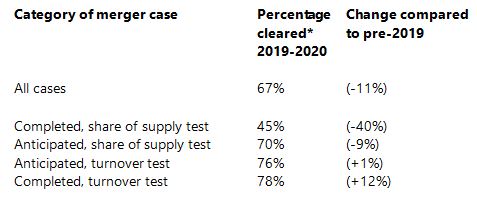
There’s been a big overall decline in the percentage of CMA cases cleared unconditionally (at Phase 1 or Phase 2)* in recent years.

It’s been much commented on and interpreted.

But it’s not quite what it seems when you look behind the headline numbers.There are very different patterns when looked at by case type.

In fact, arithmetically at least, the aggregate change is accounted for by just one type of case.

Here’s the overall pattern for 2019 and 2020 cases, with the size of the different elements proportional to the number of outcomes in each category – where

  • green = unconditional clearance at Phase 1 or 2
  • yellow = remedies at Phase 1 or 2
  • red = prohibited or abandoned …….

Source: Adrian Payne analysis of published CMA decisions

It illustrates how important it can be to look behind the aggregate numbers when considering past or potential case outcomes and when interpreting ‘trends’ in the aggregrate numbers.

In one of my next Merger Insight briefings I’m going to be discussing the reasons behind these patterns and what they mean for companies planning mergers.

—————————————————————————————

(* Percentage of publically-investigated cases. Takes no account of cases the CMA chooses not to investigate publically, on which no meaningful data are published.)

———————————————————————————————

Thank you for reading. If you found the article informative please feel free to share it using the sharing buttons nearby.

CMA Phase 2 Decisions: The Long And Short Of It

There is a lot of interest at the moment as to what governs extension of the CMA Phase 2 timetable and whether extension has been a ‘good or bad sign’ for merging parties.

In my latest Merger Insight briefing yesterday I therefore looked at the Phase 2 cases to date for which the CMA extended the timetable for review – usually by up to eight weeks.

Below is a key chart that informed the discussion.

From left to right it ranks the Phase 2 final outcomes in ascending order of the duration of the Phase 2 process.

Each case is coloured as follows:

  • Black – merger abandoned
  • Green – unconditional clearance
  • Orange – clearance with remedies
  • Red – prohibition

The chart rather explains itself….


About a third of Phase 2 investigations to date have been extended. With one or two exceptions these are concentrated in the right-hand third of the chart.

It’s immediately apparent therefore that the proportion of cases unconditionally cleared has been very low for extended cases – less than half that for cases that ran to the usual timetable.

However it’s not all bad news for parties involved in extended cases. Extension can lead the CMA to become comfortable with a relaxation of remedies proposed at the provisional findings stage and enable late-emerging evidence to be explored in full.

Even so – the fact remains that only just over one in five extended cases have ended up being cleared.

Or – to put it another way – over two-thirds of mergers that have been prohibited or remedied at Phase 2 have involved extended investigations.

The other talking point yesterday was the proportion mergers that parties have decided to abandon. But that’s a story for another day….


For details of my free Merger Insight briefings please click here.


More Mergers Going Nowhere?

There’s been a lot of attention recently on a flurry of merger transactions that have been abandoned at Phase 2 of the Competition and Market Authority (CMA) merger control process.

Some say that this is because the CMA has got tougher on mergers, especially under the leadership of Andrew Tyrie.

Overall, however, the proportion of investigated transactions that do not proceed – either because they are abandoned by the parties or prohibited by the CMA – has been almost identical under the CMA to the proportion under its predecessor body, the Competition Commission (CC).

However, the CMA allows certain deals to proceed without formal investigation that would once have been reviewed under its predecessor agencies.

If the figures were adjusted to allow like-for-like comparison it is arguable that a lower proportion of deals are abandoned or prohibited following CMA scrutiny than was previously the case.

Nevertheless, it is also the case that the percentage of investigated deals abandoned or prohibited has been at record high levels over the past couple of years, contrasting with very low levels in the CMA’s first four years.

The key question is the extent to which recent figures represent normal annual variation, a sign of tougher CMA policy or a sign that companies have attempted riskier transactions.

My own analysis suggests that the profile of cases has played an important part.

In particular, compared to previous years, there have been notable increases in the percentage of cases involving:

  • high shares of supply – and/or
  • few remaining competitors – and/or
  • close competition between the merging parties.

In 2019, for example, nearly 10% of cases involved all three features – much higher than previously.

At the same time a sharp fall in the proportion of cases involving assets with potential for divestment to solve competition problems fed directly through to:

  • more reference cases
  • more Phase 2 prohibitions
  • more companies deciding to abandon their merger.

Looking ahead, a big question is whether the fall out from the Covid-19 crisis will further embolden firms to undertake deals with significant levels of merger control risk.

————————————————————————————–

What proportion of deals investigated by the CMA has been prohibited or abandoned?Click below on the figure you think is closest to the answer:


Better Assessment of UK Merger Control Risk

Mergers and acquisitions involve the potential for the relevant competition authorities to scrutinise a deal and, if they think it may harm competition, impose remedies or prohibit it altogether.

This article focuses on merger control in the UK, by the Competition and Markets Authority (CMA).

The better the assessment of these intervention risks (sometimes known as ‘merger control risks’) the better the judgments companies are able to make on matters such as:

  • whether to go ahead with a putative transaction or to re-shape it to mitigate the potential competition risks
  • whether or not to notify deals to the CMA
    • (it’s worth noting here that non-notified deals called in for examination by the CMA were at record numbers in 2018)
  • what they need to do to manage and mitigate risks, both before and during an investigation – recognising the potential for unwelcome surprises, including:
    • unexpected merger remedies or
    • costly Phase 2 investigations that the company hadn’t anticipated
  • whether or not to offer remedies to head off problems at Phase 1 or risk reference to a full Phase 2 investigation.

In practice companies adopt a wide spectrum of approaches, ranging from no risk analysis at all right up to a full replication of the assessment that the CMA might take.

Most lie somewhere in between but many make limited use of lessons from past cases.

As a result companies are regularly surprised by Phase 1 outcomes.

With just over 300 Phase 1 merger decisions now published there are many insights available that companies can use, and in some cases are using, better to assess and manage their  prospects.

Here are four initial steps companies can take to help utilise learning from those decisions much more effectively:

1.Take into account the full range of risk factors identified in past cases, not just some of them.

Ignoring even one of the main risk factors gives an unrealistic outlook which detracts from effective planning.

Risks unrecognised cannot be mitigated or managed.

Looking across past cases, where three of the top risk factors are present the Phase 1 clearance rate has been less than 20%. (And in 2018 it was 0%).

This is orders of magnitude lower than the average clearance rate (of 67%).

What’s more, the problematic deals in this ‘higher risk’ category have been disproportionately more likely to be referred to Phase 2 investigation, rather than being remedied at Phase 1.

2. Recognise the risk in ‘low risk’ mergers

The key here is that:

Low risk is seldom no risk.

This is where CEOs have most often been taken by surprise because

  1. There is a tendency to underestimate risks in ‘lower risk’ cases (especially from factors that are largely or wholly outside the merging parties’ control) and
  2. Mergers in the ‘lower risk’ category account for a large number of cases.

Even in the 73 cases to date where none of the top competition risk factors materialised the CMA found problems in 15 of these ‘lower risk’ cases, of which 6 went on to a full Phase 2 investigation.

15 cases since the CMA began equates to 2 or 3 cases each year. That’s a lot of scope for surprise.

3. Understand the impact of different types of risk .

There are now enough previous CMA decisions to be able to gauge the influence of different factors on case outcomes and to take this into account in focusing effort on the aspects that really matter to building a stronger case.

For instance:

  • What if a transaction involves more than one type of competition issue?
  • What if customers and/or competitors complain?
  • What if a case involves many local markets?
  • What if there are unhelpful internal business documents?
  • What if these factors combine?

In an earlier blog, I looked specifically at the role that so-called ‘market shares’ have played in merger decisions.

And in this one, I showed how merging companies paid too little attention to how closely they compete with one another.

4. Learn from cases that have a similar risk profile

In preparing for a CMA merger investigation most companies take a look at what happened in previous cases in their own sector.

There’s nothing wrong with that but it does mean that a lot of relevant case-learning often goes untapped.

It can be especially insightful to look at what made the difference between clearance and non-clearance in cases with a similar risk profile to your own, including those outside one’s own sector.

In conclusion…

Understanding and managing merger control risks can help avoid costly mistakes and focus case-making effort.

The CMA’s 300 merger decisions to date provide plenty of insights that can be deployed in a very practical way in order better to manage risk and build a stronger competition case.

——————————————————————————————————————-

This article has focused on risk management and is based on analysis from my comprehensive database of CMA merger decisions.

In addition the 300 cases to date offer many other lessons as to how best to make a merger case. These feature prominently in my merger briefings.


More Merger Remedies Than Ever

The Competition and Markets Authority has just completed its fourth year.

One particular development stands out, looking at the pattern of outcomes among the 250+ CMA merger decisions since 2014….

More Phase 1 remedies: Fewer Phase 2 investigations

On average, the Competition and Markets Authority (CMA) has accepted between 3 and 4 more remedy outcomes each year at Phase 1 than the Office of Fair Trading (OFT) which had responsibility for Phase 1 mergers until 2014.

At first glance that increase doesn’t look significant…. until one considers that:

  • the average number of Phase 1 remedies under the OFT was only 5 in the first place and that
  • the CMA has been formally considering 30% fewer cases than did the OFT.

The number of references to Phase 2 is on average just over 3 lower each year than it was before the CMA took over responsibility for Phase 2 mergers from the Competition Commission.

Pre-CMA the average annual number of references was 11.

While there is not be a direct one-for-one relationship between the increased average number of remedies and the lower average number of references, a  link would not be too surprising given the CMA’s stated policy of resolving more cases at Phase 1.

Overall, the percentage of problematic Phase 1 cases resolved through Phase 1 remedies, rather than reference to Phase 2, has been more that a third higher in the CMA’s first four years than for any four-year period under the OFT.

What has been the change in the pattern of outcomes at Phase 2?

The reduction in the average number of Phase 2 cases under the CMA reflects, in order of scale of change:

  • fewer mergers being abandoned on reference to Phase 2
  • fewer Phase 2 clearances
  • the near elimination of Phase 2 prohibitions and
  • a lower number of Phase 2 remedy outcomes.

This is consistent with the notion that, if there is some link between more Phase 1 remedies and fewer references to Phase 2, it is the more ‘marginal’ and more ‘fragile’ that may have been most affected.

If so it means that some cases that might have been cleared at Phase 2 are undergoing merger remedies at Phase 1.

This may be one reason why the proportion of cases being unconditionally cleared at Phase 1 or at Phase 2 is sharply lower under the CMA than it was under the OFT. (Another is the CMA’s greater selectivity in which cases formally to investigate.)

How Are Companies Responding?

Judging from conversations during some of my recent merger briefing sessions ,some companies considering or implementing mergers are already paying much closer attention to the potential for a Phase 1 remedy outcome than used to be the case.

This includes thinking harder about the more expansive types of Phase 1 remedy that the CMA has shown itself prepared to consider and accept.

For some it also means attending more to how they shape and scope their transactions and how they measure the degree of merger control risk they are taking on.

There are plenty of lessons merging companies can learn from the CMA’s 34 Phase 1 remedy cases so far – the subject of one of my recent briefings.

In recent months the rate of remedied cases has come back somewhat from its peak. Looking ahead, it will be interesting to see, therefore, whether we have already reached ‘peak Phase 1 remedy’.


A Closer Call – UK Merger Control Decisions in 2017

As 2017 draws to a close here are some of the distinctive features of this year’s merger decisions by the UK’s Competition and Markets Authority.

The picture I present is a bird’s-eye view, rather than a commentary on individual cases (which I will cover separately in my Merger 2017 A-Z briefings).

In particular, I focus on noticeable differences between this year’s cases (taken as a whole) and the overall pattern of CMA decisions across previous years, since the agency took over from its predecessor bodies in April 2014.

I focus on the 60 Phase 1 decisions in 2017 to date as there are too few Phase 2 cases to enable a meaningful comparison.

In what follows reference to ‘SLC’ cases means those Phase 1 decisions that found that the merger brings a reasonable prospect of a ‘substantial lessening of competition’.

Below I look at:

  • The pattern of cases
  • Decision outcomes
  • Theories of harm
  • Evidence
  • Key reasoning behind the decisions
  • Analysis
  • Implications for companies

Pattern of cases

  • Across the 60 Phase 1 published decisions in 2017 to date there has been a similar profile to the overall profile for previous years in terms of market concentration, though with more cases with 90%+ shares of supply
  • A much higher proportion of cases qualified for investigation under the ‘turnover test’ for jurisdiction, as opposed to the ‘share of supply’ test.

Decision outcomes

  • A much greater proportion of SLC decisions, almost wholly accounted for by….
  • A much higher proportion of cases dealt with by Phase 1 remedies – so-called ‘undertakings in lieu of reference’ to a Phase 2 investigation
  • A noticeably larger proportion of remedy findings among cases in which the parties had middle ranking shares of supply and/or modest increments to the share of supply

Theories of Harm

  • A much smaller proportion of cases in which a ‘potential competition’ theory was examined (i.e. the notion that the parties may compete in the future even if they have not to date). Previously such cases have proved untypically problematic for competition.

Evidence

  • Customer surveys and diversion evidence featured much more regularly
  • Clearance decisions relied noticeably more on third party evidence
  • Cases in which bidding analysis was key were much more frequently problematic than on average across previous years
  • A noticeably lower proportion of cases attracted complaints from rival firms

Key reasoning behind the decisions

  • ‘Closeness of competition’ between the merging parties featured prominently in a much higher proportion of cases than on average previously – to the extent that, in 2017, it was the most important of the three main reasons behind clearance decisions when taken as a whole. This was also the case for SLC decisions when taken as a whole
  • The number of rival firms remaining after the merger (another of the CMA’s three main decision reasons) was much less important in the reasoning behind SLC cases taken as a whole compared to previously, when it was the most prominent factor overall.

Analysis

  • The following topics all had a much higher profile in 2017 cases than on average previously:
    • Customer benefits through merger
    • Customer switching between rivals
    • Bidding analysis
    • Customer catchment areas
    • Customer surveys

Implications

What are the implications of the above for companies contemplating or planning a merger?

Click here for my summary assessment.

I shall be talking more about the above, as well as about the many other lessons to be learnt from individual cases within this year’s portfolio, at my customary January ‘Merger A-Z’ briefing events.

2015/16: A Record Year For UK Merger Control

This post looks at the pattern of merger control decisions during the Competition and Markets Authority’s (CMA’s) second full year, which ended on March 31st. The decisions covered are those for which final decisions were published during the year.

In summary:

2015/16 turns out to have been a record-breaking year in many different respects

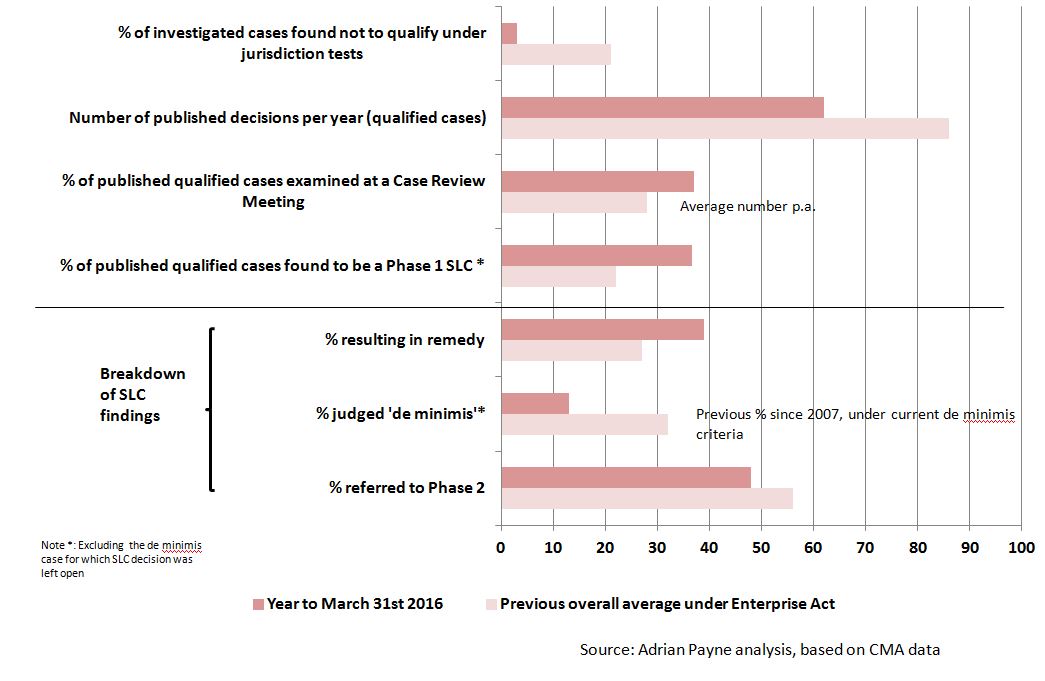
  1. A record low number of Phase 1 merger decisions

The 62 published CMA Phase 1 decisions was the lowest number of any year since the Enterprise Act came into force and well down on 2015/16.

A third successive sharp drop in the number of non-notified mergers that the CMA ‘called in’ for investigation contributed to the fall. Only 10 cases were called in, the lowest number I can recall for any year. Another record.

Phase 1 Merger Decisions – 2015/16 compared to previous years
160406-phase 1 figures 15-16

2. A record low number of decisions was found not to meet the jurisdiction criteria

The number and proportion of published cases found not to meet the qualifying tests for jurisdiction was in 2015/16 a fraction of its historic average – and by far the lowest in any year so far under the Enterprise Act.

3. Phase 1 competition problems at a record high

The proportion of Phase 1 cases meeting the jurisdiction tests (so-called ‘qualified cases’) that was found to threaten a ‘substantial lessening of competition’ (SLC) doubled compared to the CMA’s first year and reached a record high of 38%.

There are two elements to this that are worth noting:

  • Cases that are candidates for a Phase 1 SLC decision are examined in detail at a so-called ‘Case Review Meeting’, late in the Phase 1 process. The proportion of cases taken to a Case Review Meeting was well above average in 2015/16.
  • And of those cases, over 80% resulted in an SLC finding – again well above average.
  1. The lowest ever proportion of cases decided at Phase 1

The proportion of qualified cases decided at Phase 1 was the lowest to date under the Enterprise Act.

This result stems from the fact that, even though the proportion of problematic cases referred to Phase 2 for further investigation was well below average, the percentage of problematic cases in the overall caseload was at a record high, as described above.

  1. The proportion of problematic Phase 1 cases deemed too small to merit a Phase 2 investigation was at a record low

This statistic relates to so-called ‘de minimis’ cases. It is a great example of how one needs to look at individual cases (both notified and un-notified) in order to interpret the result.

Might it indicate that the CMA is taking a harder line on arguments put to it that a case is too small to warrant further investigation? Or does it show that the CMA is calling in fewer potential ‘de minimis’ cases? Cases strongly favour the latter.

6. A record high for Phase 1 remedies

The proportion of problematic cases dealt with by remedies at Phase 1 rose to a record high of nearly 40% in 2015/16.

It is striking that, at one point during the year, seven out of ten consecutive SLC decisions (excluding de minimis cases and automatic references) were dealt with through Phase 1 remedy rather than reference to Phase 2, another record under the Enterprise Act as far as I recall.

It is interesting that this is in the context of there being….

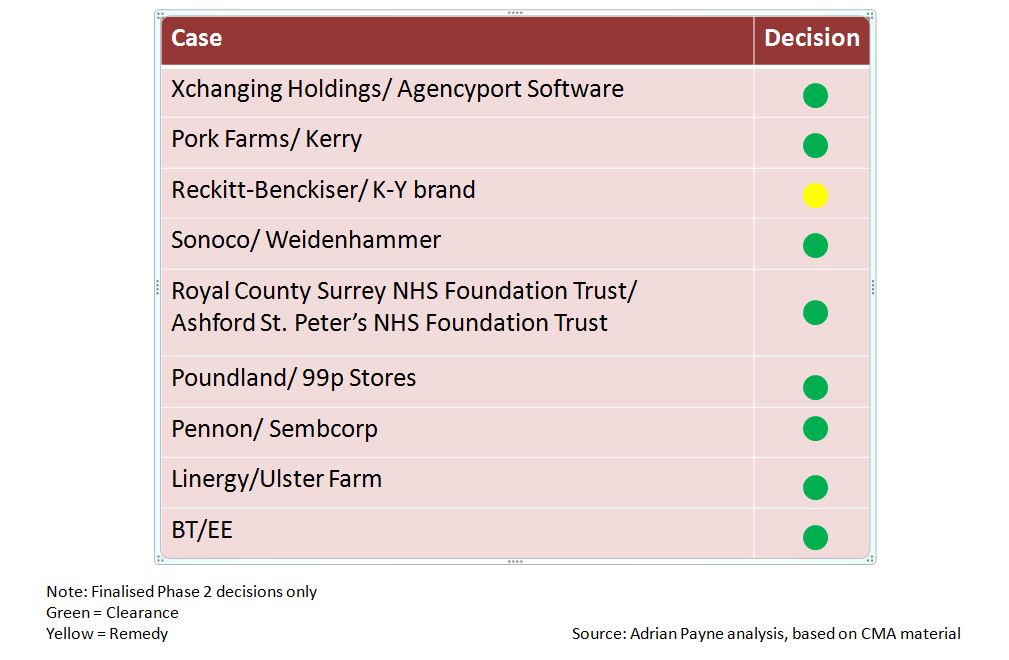
7. No Phase 2 prohibitions for the second consecutive year.

This means that the CMA Phase 2 decision-makers have yet to prohibit a merger.

There have, however, been two previous occasions in which there have been no prohibited mergers for two consecutive years. So this one isn’t a record !

2015/16 – CMA Final Phase 2 Merger Decisions
160406-phase 2 decisions 15-16

Looking ahead

Where does this cascade of new merger records leave the CMA, merging firms, competitors and customers?

There is little doubt that the CMA has become increasingly selective in the cases it has chosen to call in for investigation, to a degree that requires highly reliable information being available from merging parties in order to enable the CMA to avoid missing too many problematic deals of reasonable size.

The particular challenge here for the CMA is to make these ‘call in’ decisions accurately and quickly outside of the formal review process, without the range and quality of cross-checks that comes from interaction with competitors and customers when a case is called in for review.

As some have already recognised, for merging parties greater CMA selectivity is clearly relevant to decisions regarding notification. A key question, therefore, is whether the CMA will decide to be as selective in the year ahead. It is worth remembering here that there has already been more than one occasion under the Enterprise Act when tighter case selection has been followed by a move back to a more expansive approach to calling in cases for review.

For customers and competitors greater CMA case selectivity clearly puts a premium on making representations more quickly, rather than waiting for a formal investigation to begin. The much-expanded role for pre-notification also points in this direction, as does the earlier involvement of the Phase 1 decision-maker than used to be the case.

Turning to substantive decisions made during 2015/16 , as the National Audit Office recently put it, “the CMA is expanding the practice of clearing cases with remedies in phase 1 without the need to go for a more detailed and resource-intensive phase 2 review.”

It would be easy, however, to overstate the extent to which the 2015/16 remedies record is due to the CMA’s expanded Phase 1 remedy ambitions. In particular, the increasing level of challenge in many deal valuations (a factor in the low number of deals) seems to me to have had a notable effect on the appetite for regulatory risk and therefore the pattern of deals being brought to fruition (including their suitability for Phase 1 remedies).

Two other questions are also relevant here:

  • To what extent has the way in which CMA plans and manages its casework (now that Phase 1 and Phase 2 are under one roof) affected the pattern of Phase 1 decisions being made?
  • And what has been the impact of certain ‘bold’ Phase 2 clearance decisions on the attitude to remedies at Phase 1, both by parties and by the CMA?

On the whole, my own 2015/16 casework leads me strongly to suspect that the CMA’s record-breaking year for mergers hides patterns that are more complicated than they first appear from the aggregate statistics.

As always, many of the main lessons for interested parties to future mergers come from understanding what has worked well or badly in individual cases during 2015/16, as well as from understanding what the aggregate figures do and do not show.

In both respects 2015/16 should leave plenty of pause for thought for all concerned.

——————————————————-

© Adrian Payne, 2016