
Subscribe to continue reading
Subscribe to get access to the rest of this post and other subscriber-only content.

Subscribe to get access to the rest of this post and other subscriber-only content.
Subscribe to get access to the rest of this post and other subscriber-only content.
Subscribe to get access to the rest of this post and other subscriber-only content.
Some companies try to argue to the CMA that the company they are acquiring
a) has been earning less than the cost of capital
b) can only invest in desirable future technology by becoming more profitable through merger and
c) will inevitably become less competitive if the merger does not proceed (and maybe even exit altogether).
One of the problems with this general argument is the scale of capital expenditure that takes place in companies that earn below the cost of capital.
For example, around 30% of capital expenditure by companies in the UK’s All Share index over the past five years has been made by companies earning an average 5-year return on equity of less than 5%. (Source: analysis using Sharescope)
The position is very similar if one uses return on capital employed instead of return on equity.
It’s very clear, then, that – in general – a low return is not anywhere near an absolute impediment to investing.
Nor is it clear that companies with low returns invest less. In fact the data suggest they invest a higher proportion of their sales and of their operating cashflows.
Which is no surprise. After all, companies with low returns have a strong incentive to invest in order to increase those returns.
What does this mean for companies wishing to put forward credible arguments along these lines?
The big point is that arguments of this sort can sound impressive but often lack supporting evidence when one looks across companies generally.
Instead the argument only begins to be credible if there are reasons very specific to the case at hand why low returns inevitably and significantly impair the ability to invest in a way that will benefit consumers.
If you want to make this type of argument, therefore, here are three questions that I have found it essential to ask:
a) what makes the argument so compelling in this particular case?
b) what specific evidence is there to support each limb of the argument you are making?
c) how well does each part of the argument stand up to good stress-testing and strong challenge?
Here’s a selection of some of the best articles I have read recently that are relevant to UK merger control………….
1. Spend, Spend, Spend
How much did the CMA spend on the first part of its investigation into the Microsoft/Activision merger? In this article, Justin Cash looks at the numbers.
2. The Dye Is Cast
Ben Lask and Thomas Sebastian consider here the CAT decision regarding the Dye and Durham merger.
3. What Is ‘Dynamic Competition’?
Andrew Swan and colleagues discuss the matter here.
4. More Hype Than Reality?
In this paper Marc Ivaldi and colleagues examine whether so-called killer acquistions are as common or problematic as merger control authorities seem to think.
5. Rarity Value
Here Stephen Smith and colleagues present a rarity – a balanced assessment of the long-running Microsoft/Activision saga. Do let me know if you’ve spotted others.
6. Tougher Than The CMA
Nicole Kar and colleagues look here at the Bookings/Etraveli case, cleared by the CMA but prohibited by the EC.
Strange that noone has been moaning about the ‘divergence’ between the two agencies in this case, unlike other ‘divergent’ examples. I wonder why. Thoughts?
The CMA opened its Phase 1 investigation into the Vodaphone/Hutchinson merger today.
The parties will be hoping to defy the track record of CMA merger cases opened in October:
Ranking within months of the year – respectively:
What’s wrong with October?
I have my theory. What’s yours?
In June the CMA published its 500th merger decision.
There’s little doubt that the profile of UK merger decisions has developed a lot since the CMA began. No surprise there, as a great deal can happen over 9 years.
It seems that many readers (especially advisers) are sympathetic to the first of the somewhat tongue-in-cheek narratives I set out in my previous blog, although with a more measured overarching headline, along the lines that the CMA has become much stricter on mergers.
But what lies below that sort of headline?
What exactly does it mean? And for whom?
And what call to action should it have for merging parties, investors and others?
The reason these questions are important is revealed when one looks below the aggregated statistics that the CMA publishes by using data published in case decisions.
In future blogs I plan to say more on all of this, based on recent research I have been doing looking at the CMA’s first 500 merger cases – ‘The CMA At 500’.
Comparing the first 250 and the second 250 brings out many unexpected similarities and differences.
The ‘stricter enforcement’ narrative, it turns out, is much more nuanced that it might first appear from the headline numbers and applies unevenly across different types of case.
Many companies relying on the simple headline ‘stricter trend’ in thinking about merger control risk will be well wide of the mark. The average is different from the typical.
If interested, do watch out for my blogs on ‘The CMA At 500’ or contact me to find out more about my presentation on the research.
Number Four in my look back at 2022…..
This was the year in which there were more Phase 1 merger interventions than unconditional clearances (among Phase1 decisions published during the year) – for the first time.
Despite the very low number of published Phase 1 decisions, the number of remedy decisions was well above the CMA average (10 versus 6) and the highest since 2017.
The number of reference-to-Phase-2 decisions was just above the average for previous years (11 versus 10).
Also:
Between 2017 and 2021 the number of references had been more than twice the number of remedies.
In 2022 they were roughly even.
2022 is also, therefore, the year in which Phase 1 remedies came into their own again.
There’s been a big overall decline in the percentage of CMA cases cleared unconditionally (at Phase 1 or Phase 2)* in recent years.
It’s been much commented on and interpreted.
But it’s not quite what it seems when you look behind the headline numbers.There are very different patterns when looked at by case type.
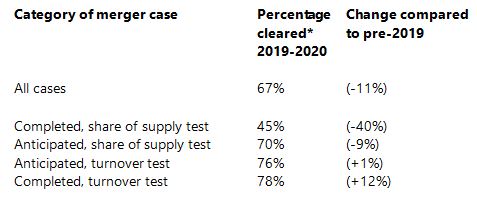
In fact, arithmetically at least, the aggregate change is accounted for by just one type of case.
Here’s the overall pattern for 2019 and 2020 cases, with the size of the different elements proportional to the number of outcomes in each category – where

Source: Adrian Payne analysis of published CMA decisions
It illustrates how important it can be to look behind the aggregate numbers when considering past or potential case outcomes and when interpreting ‘trends’ in the aggregrate numbers.
In one of my next Merger Insight briefings I’m going to be discussing the reasons behind these patterns and what they mean for companies planning mergers.
—————————————————————————————
(* Percentage of publically-investigated cases. Takes no account of cases the CMA chooses not to investigate publically, on which no meaningful data are published.)
———————————————————————————————
Thank you for reading. If you found the article informative please feel free to share it using the sharing buttons nearby.
There is a lot of interest at the moment as to what governs extension of the CMA Phase 2 timetable and whether extension has been a ‘good or bad sign’ for merging parties.
In my latest Merger Insight briefing yesterday I therefore looked at the Phase 2 cases to date for which the CMA extended the timetable for review – usually by up to eight weeks.
Below is a key chart that informed the discussion.
From left to right it ranks the Phase 2 final outcomes in ascending order of the duration of the Phase 2 process.
Each case is coloured as follows:

The chart rather explains itself….
About a third of Phase 2 investigations to date have been extended. With one or two exceptions these are concentrated in the right-hand third of the chart.
It’s immediately apparent therefore that the proportion of cases unconditionally cleared has been very low for extended cases – less than half that for cases that ran to the usual timetable.
However it’s not all bad news for parties involved in extended cases. Extension can lead the CMA to become comfortable with a relaxation of remedies proposed at the provisional findings stage and enable late-emerging evidence to be explored in full.
Even so – the fact remains that only just over one in five extended cases have ended up being cleared.
Or – to put it another way – over two-thirds of mergers that have been prohibited or remedied at Phase 2 have involved extended investigations.
The other talking point yesterday was the proportion mergers that parties have decided to abandon. But that’s a story for another day….
For details of my free Merger Insight briefings please click here.
 Adrian Payne