Last updated: February 29th 2016
Which were the most interesting UK merger decisions of 2015, in terms of the competition analysis undertaken?
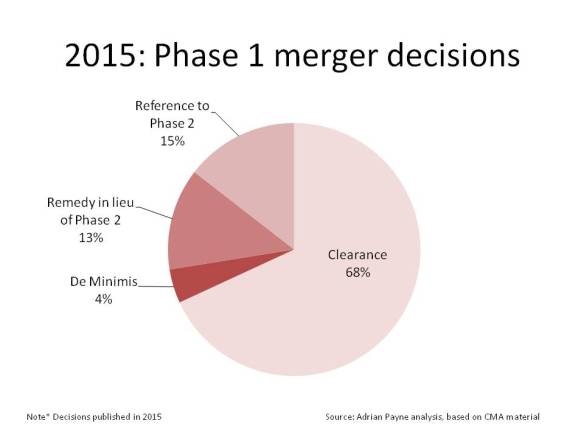
Here are my nominations, chosen from those cases that have completed their passage through CMA scrutiny (whether that was a Phase 1 assessment only or a Phase 2 inquiry as well) and for which a full final decision has been published.
To link straight to the CMA’s published decision for a case, please click on the blue highlighted titles.
Regus Group/Avanta Serviced Offices Group – Phase 1 undertakings in lieu of reference to Phase 2
The CMA found competition concerns in five areas of Central London and accepted divestments and a behavioural remedy to deal with these problems.
Points of interest included:
- Comments by the CMA on the importance of the timely provision of evidence:
- “At phase 1 the CMA has limited time to assess whether its duty to refer applies. The earlier that merging parties submit economic analysis supporting their case, the better-placed the CMA will be to assess that evidence and attribute appropriate weight to it. Accordingly, where possible, the CMA encourages merging parties to engage with it prior to commencement of the 40-working-day review period where they are considering submitting economic analysis.” – (Decision – paragraph 40)
- Statistical analysis by the parties of a previous merger in the sector: The CMA reworked the analysis and produced more concerning results
- The extremely detailed assessment of rival office capacities at a very local level, including the cross-checking of the parties’ figures with third parties
- The disregarding of two office closures that took place before the merger and that would have created overlaps between the parties
- The weight put on evidence of specific examples of local entry by rivals rather than on general ‘low barriers to entry’ arguments
Muller/Dairy Crest dairy operations – Phase 1 undertakings in lieu of reference to Phase 2
The CMA found competition concerns only in the supply of fresh liquid milk to national multiple retailers in the catchment area of Dairy Crest’s Severnside dairy, especially in the South West and Wales. Undertakings in lieu of a Phase 2 investigation were offered and accepted.
Particular points of interest are:
- This is the first time that the new agency has accepted at Phase 1 arguments to the effect that assets would inevitably exit the market in the absence of the merger. (This was important because it enabled the CMA to conclude that, in certain products and geographic areas, the merger itself would not decrease competition compared to what it would otherwise be). In this case the CMA accepted the parties’ arguments that Dairy Crest would ‘downsize’ to a single dairy (Severnside) if the merger did not go ahead.
- The CMA did not, however, accept the parties’ arguments that Dairy Crest would inevitably exit the supply of fresh milk to national multiple retailers if the deal did not proceed. This was largely because there was no mention of this in internal documents and because spare capacity at the plant would give both the ability and incentive to bid for contracts.
- The CMA also rejected the parties’ arguments that milk supply is an ‘ideal bidding market’ in which strong competition can be achieved with few companies. The CMA concluded that none of the conditions required for such an outcome would be fulfilled. Neither did it accept that tenders follow an ascending (second price) auction model, as the parties claimed.
- The nature and complexity of the remedies package (which is based around a toll agreement for processing at Severnside, lasting for up to 8 years) brings out how different the Phase 1 remedy process can be under the CMA compared to Phase 1 under the OFT. The published decision on remedies itself runs to 45 pages. (One factor here is that the CMA has a greater ability as a single agency to decide on how to allocate resources as between the two phases of merger investigation than was the case when the two phases were undertaken by separate organisations. This gives greater scope for deciding that remedies are sufficiently clear-cut to avoid a Phase 2 investigation).
Poundland/99p Stores – Phase 2 clearance
At Phase 1 the CMA found potential concerns about the effect of the merger on competition in 92 local areas on the basis of a fairly standard retail merger assessment.
The CMA was highly critical of aspects of the parties’ online survey (as well as other aspects of their evidence such as their price-concentration and entry analysis) and therefore used cautious criteria to identify the local areas of concern in its Phase 1 assessment.
At Phase 2 the CMA commissioned its own survey covering a sample of 15 local areas. The results were used to construct a method that could be used to calculate so-called ‘Indicative Price Rises’ across all the overlap areas based on features such as the number and type of competitors and their proximity to one another.
An appendix to the Phase 2 report compares the results of the Phase 2 face-to-face survey with the Phase 1 online survey. It is a useful reminder of how much survey design can affect results.
Notwithstanding the price rise analysis, the CMA’s Phase 2 panel concluded, however, that the parties would not be likely to flex terms and conditions locally to take advantage of their stronger position in certain locations. This was based on evaluating the practicalities involved and the costs and benefits of changing certain aspects of its local offering.
The survey and profitability margin figures suggest that there could be strong incentives for the parties to close outlets in some areas where they both operate. The CMA concluded, however, that consumers would be unlikely to be harmed by any such closures because the parties have similar offerings and are located close to one another in the potential areas of concern. On this analysis customers would not therefore need to travel much further where they have to switch to the other outlet.
Despite a high level of interest in the case there were no third party submissions challenging the CMA to develop the reasoning published in its provisional Phase 2 findings. Similarly the provisional clearance decision meant that the parties themselves did not need to challenge further certain parts of the analysis. As a result the final report leaves open interesting questions that may need exploring in future retail cases.

Reckitt/K-Y brand – Phase 2 licensing remedy
The CMA found harm to competition in the supply of personal lubricants to grocery retailers and to pharmacy chains.
There are many points of interest from both the Phase 1 and Phase 2 analysis, including:
- The importance of ‘indicative price rise’ (IPR) analysis to the Phase 2 assessment, drawing on the results of a large consumer survey.
- Also on this: many debates between the parties and the CMA on methodology and interpretation, including about the link between wholesale and retail prices
- The CMA set out an approach to identifying so-called ‘marginal’ customers – those most likely to switch as a result of a price rise
- Phase 2 analyses of competition by examining the effects of previous price changes and of price promotions
- Many comments in Phase 1 on the parties’ own survey work and on other elements of their evidence
- Close analysis of the future of the K-Y brand in the UK in the absence of the merger (the so-called ‘counterfactual’)
- An eight year licensing remedy to position new entry, judged to be preferable to other remedies, including brand divestment. The idea is that the licensee will take over the K-Y product in the UK and rebrand it during the eight year period.
Surrey hospitals merger – Phase 2 clearance
Royal Surrey County Hospital NHS Foundation Trust (RSC) and Ashford and St Peter’s Hospitals NHS Foundation Trust (ASP) provide clinical services from their sites in Guildford, Ashford and Chertsey.
The clearance decision is significant because it is the first Phase 2 clearance of an NHS merger.
The case contains many developments of interest at Phase 2, including:
- recognition of the importance of accurate treatment coding and the significant effect that it can have on the assessment for some treatments
- taking into account the competition impact of developments at rival hospitals that are not captured in analysis of historic figures such as GP referral patterns
- caution in the use of the results of a large patient survey in the light of the high proportion of patients who did not have a clear view on which alternative hospital they would choose if they had to switch
- use of ‘closest hospital’ analysis to examine the proportion of a hospital’s patients for which other alternative hospitals would be closest.
At Phase 1, Monitor accepted the case that three treatment areas would give rise to so-called ‘Relevant Customer Benefits’ (though those were not sufficient to avoid a Phase 2 reference).
Tattersalls/Brightwells – Phase 1 – No competition conclusions made. Deemed too small to merit a Phase 2 investigation
This case involved the merger of two bloodstock auctioneers. The CMA said that it could not rule out the possibility of competition concerns (set out below) but did not find it necessary to conclude on these because the concerns would be too small to justify a Phase 2 investigation
To qualify for consideration as a so-called ‘de minimis’ case the competition problems identified must be of a type that cannot in principle be remedied (otherwise the possibility of reference to Phase 2 would not arise anyway). As the CMA noted in this instance:
“The CMA’s concerns regarding the supply of bloodstock auctioneering services for low-value flat racing horses in training in the UK and Ireland may in principle have been addressed by the divestment of the Ascot lease. However, the CMA found that the competition concerns that the Merger raises in terms of elimination of Brightwells as a potential competitor in the supply of auctioneering services for store horses do not led (sic) themselves, in principle, to being addressed through UiLs in the specific circumstances of this case”.
Clearly the range of such problems left open can differ from the range of problems judged to raise competition concerns if the analysis is completed and conclusions are drawn – for example where the former include competition problems that cannot in principle be remedied and the latter include only problems that can.
Could leaving open the competition conclusions in a case therefore itself affect whether a case qualifies as too small to justify a Phase 2 investigation? In this case, for example, if the CMA had completed its Phase 1 assessment and decided that the only competition concerns related to the Ascot lease it would presumably have sought a divestment in lieu of a reference to Phase 2 and would not have permitted a de minimis outcome.
Other interesting aspects of this particular case include:
- Internal documents said to show a valuation premium being paid for the elimination of competition, high barriers to entry for new competitors and plans to compete in new areas (so-called ‘potential competition’)
- A different product/service categorisation to that used in a previous decision in the same sector ( a good example of how parties should not place too much weight on previous decisions)
- Analysis showing how comparisons of average prices charged can give a misleading picture of how closely two companies compete.
Sonoco/Weidenhammer – Phase 2 clearance
Sonoco and Weidenhammer both produce ‘composite cans’ for packaging both food and non-food products, with a very high UK share of supply.
Points of interest include the importance to the clearance decision of:
- the ability of customers to switch to alternative forms of packaging or to move to self-supply
- new suppliers being likely to enter the market if prices increased (or quality decreased), potentially sponsored by larger customers looking for alternative suppliers
- the resulting additional volumes being sufficient to protect the interests of customers not willing or able to sponsor entry.
None of these seemed particularly promising arguments on the basis of the Phase 1 assessment.
The CMA found no significant competition concerns on most routes where East Coast services overlap with existing Stagecoach or Virgin Trains rail or coach services. They found, however, that the franchise award could mean higher fares or reduced service quality for rail passengers travelling between Peterborough, Grantham and Lincoln and for coach and rail passengers travelling between Edinburgh, Dundee and Aberdeen.
Points of interest include:
- Analysis of the way that government support increases the parties’ incentives to increase price or reduce quality
- The framework used to assess incentives affected by the balance between dedicated fares and inter-available fares
- Rejection of the argument that the small increment on a flow is sufficient reason to conclude that competition concerns cannot arise
- The range of remedies accepted: including price cap, separation of decision-making and price monitoring.
Greene King/Spirit – 16 divestments in lieu of reference to Phase 2
In its first review of a merger between major pub operators, the CMA has adopted a long overdue fresh approach to the way transactions in this sector are assessed.
The many points of interest include:
- The use of an internet survey of certain customers of 40 of the parties’ pubs to help inform how to assess the catchment area for identifying overlaps. (In previous cases administrative areas for licensing had been used)
- A distinction between food-oriented pubs and so-called wet-led pubs
- A 35% combined share of pubs in a catchment area was deemed to raise possible competition concerns (56 areas in all)
- Further criteria applied included:
- A ‘discount’ factor to give some weight to the constraint of wet-led pubs on so-called ‘dry-led’ pubs (30 areas)
- Location and proximity of pubs (2 areas)
- Flexing drive time-assumptions (4 areas)
- Price pressure analysis (2 areas)
- Comparison of menus and Trip Adviser ratings ! (2 areas)
The big question is how soundly-based this new approach is as there is very little commentary in the published decision on the internet survey that underlies it and no significant reference to the sensitivity of results to changes in the main variables, including the ‘discount’ factor.
These factors also make it difficult to tell how cautious (or not) the assessment was for a Phase 1 decision.
The Original Bowling Company/Bowlplex – 6 divestments in lieu of reference to Phase 2
The decision packs a lot in to its 29 pages. Analytical points of note include:
- CMA concerns with both the sample and questionnaire design for the parties’ telephone survey results
- Statistical analysis to examine the impact of entry and exit by rival bowling operators and by cinemas
- Much of interest on so-called ‘catchment areas, including the differences between the analysis produced using the CMA’s software and that used by the parties
- The use of price pressure analysis (so called ‘GUPPI’ analysis) to help identify areas of most concern and the rejection of the parties’ arguments against the validity of this approach
- No mention of any potential for the merger to reduce competition by removing the opportunity for the parties to enter new areas to compete with the other (so-called ‘potential competition’).
——————————————————————————————–
My training seminar ‘The 17 UK Merger Cases Most Worth Knowing About’ looks at that select band of cases that have most influenced how UK mergers are assessed. Details available on request.






 Adrian Payne